
Marble vs Granite vs Quartz: Which Stone Is Best for Your Home? :
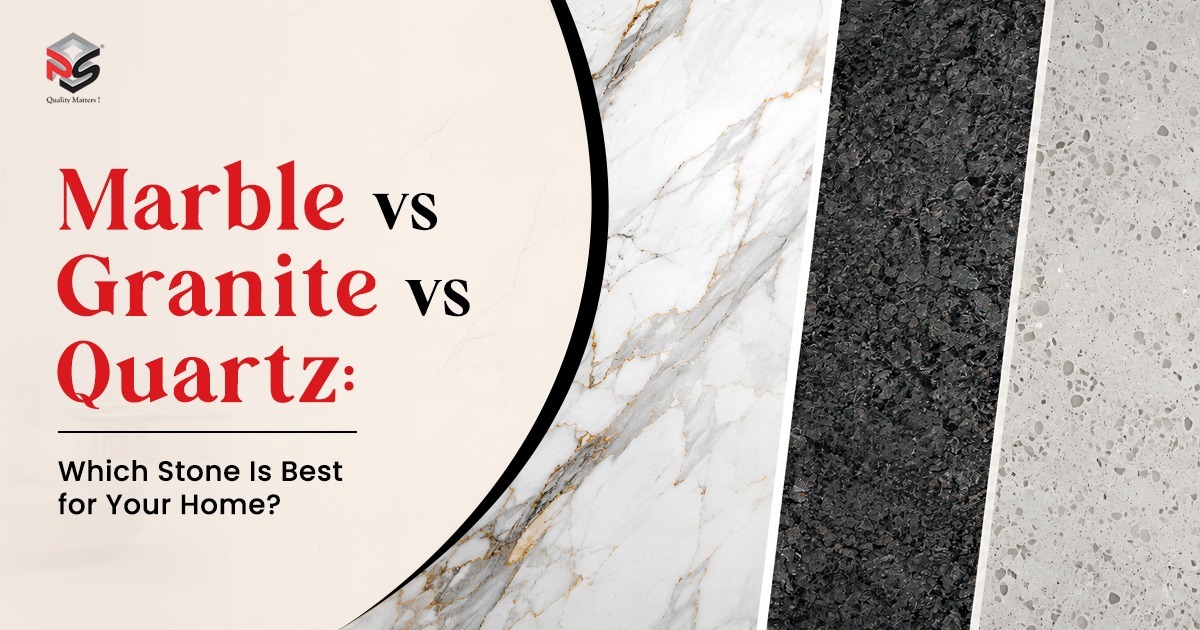
Have you ever wondered why two similar homes look so different after 10 years? The main reason behind this is the choice of stone. One home’s kitchen and floor may shine like new for decades, while another may show signs of stains. To prevent such instances, choose stones that match how you actually use the space, and the rest becomes easy. A slab may look perfect under showroom lights, yet it may look different in your home. This is why the smart move is to first understand the material suitable for your home.
As a leading marble and granite supplier, Pahariya Stones, Jaipur, answers these questions every day. This guide to Marble vs. Granite vs. Quartz compares all three on looks, strength, cost, and care, so you can choose with clarity.
Marble vs Granite vs Quartz: Quick Comparison Table
Before exploring the det
| Property | Marble | Granite | Quartz |
| Type | Natural stone | Natural stone | Engineered (90%+ ground quartz + resin) |
| Durability | Moderate, can chip and etch | Very high | Very high |
| Heat resistance | Good, but can mark | Excellent | Limited, sudden high heat can scorch the resin |
| Maintenance | High, needs regular sealing | Medium, periodic sealing | Low, no sealing needed |
| Best for | Vanities, feature walls, low-traffic floors | Kitchens, staircases, outdoor, high-traffic floors | Kitchen counters, vanities, indoor wet bars |
What Is Marble and Where Should You Use It?
Marble is a natural stone known for its elegant veining and cool, smooth surface. It is made up of limestone under heat and pressure. Among homeowners, it is preferred for places where beauty matters the most.
Pros of Marble
One of the greatest characteristics of marble is its timeless beauty. Here is what makes marble suitable for elegant spaces:
- Stunning veined patterns that add a premium, natural look
- Cool stone surface that is ideal for rolling dough and baking
- Can either be made shiny or honed for a matte look
- Available in numerous colours, including the classic white of Makrana Marble and the highly veined Italian marbles
Cons of Marble
Marble is soft and porous. Because of that, it can scratch, stain and etch if not cared properly. That’s why, keep these limitations in mind before you choose marble for your home:
- Scratches more easily than granite or quartz
- Etches and dulls when it meets acids like lemon, vinegar, or curd
- Absorbs spills if left unsealed, so it needs sealing every 6 to 12 months in wet areas
- Higher day-to-day upkeep than engineered surfaces
Best Rooms/Uses for Marble
Marble greets you with a cool, calm feel that lasts for years. Among the most popular Indian & Italian marble collections, marbles are mostly preferred for the following spaces:
- A bright marble floor flows from the main entrance into the drawing room, where guests are welcomed in style
- A serene marble mandir that turns your pooja corner into the calmest spot in the house
- A grand staircase wrapped in marble that instantly lifts the whole home
- A softly veined vanity in the guest bathroom that quietly wows every visitor
- A cool marble slab in the prep corner, just right for rolling out rotis and mithai
What Is Granite and Where Should You Use It?
Granite is a natural stone that is formed from cooled magma, and that origin makes it exceptionally dense and hard. It has higher resistance to heat, scratches and wear.
Pros of Granite
Granite offers excellent resistance to wear. The following are some of its main benefits:
- It is one of the hardest natural stones, rated at 6 to 7 on the Mohs scale
- On granite surfaces, you can place objects above 60°C without any fear of being damaged
- The stone’s natural grain gently hides small marks and water spots, so the surface looks clean for a longer period
- It stays just as strong outdoors, and its surface is not much affected by the UV rays of the sun and heavy rain
Cons of Granite
Granite is a low-maintenance stone, but it still has some drawbacks. Keep these points in mind before you buy:
- It soaks up liquids if it is not sealed, so oil or water can leave a mark
- Granite slabs require periodic resealing
- It has considerable weight and requires strong cabinetry to support granite slabs
- Thinner or lower-grade slabs chip at the edges, and such damage may require frequent repairs
Best Rooms/Uses for Granite
Granite is best suited to the busiest areas of a home, where heat, water and heavy use come together through the day. A great granite collection gives you a shade to suit each of the following spaces:
- On the main kitchen counter, it comfortably withstands chopping of vegetables/fruits, cooking and hot cookware.
- Around the sink and washing area, it withstands constant water and steel utensils without losing its finish.
- On the serving ledge, it holds warm dishes brought straight from the stove while meals are served.
- Along the entrance and staircase, it endures steady footfall and continues to look solid for years.
What Is Quartz and Where Should You Use It?
Quartz is a hard, crystalline mineral composed of silicon dioxide (SiO₂). This mixture gives the stone a smooth, even surface that can resist stains for a longer period.
Pros of Quartz
The quartz’s non-porous body keeps the slab clean and hygienic without any sealing. The main advantages of quartz are:
- Quartz slabs are resistant to water, oil, and spills of regular drinks like tea
- It does not get easily scratched from knives, steel plates, furniture marks and everyday chores.
- These slabs come in bright and solid colours that look vibrant in homes
Cons of Quartz
Quartz resin content makes it sensitive to heat and long hours of direct sunlight exposure. The main limitations of quartz slabs are:
- On long counters and islands, the join between two slabs can stay visible, and lighter shades make it harder to hide.
- With veined or patterned quartz, the design often does not carry over to the polished edge, so the sides can look flatter than the top.
- Light and white quartz may yellow near sunny windows as the resin ages
- Ink, food colour, and turmeric can still leave a mark if left too long, unless thoroughly cleaned
Best Rooms/Uses for Quartz
You can use Quartz slab indoors, in spaces that need a clean, low-maintenance surface. Most of the Quartz Stone range works well in these places:
- Bathroom vanities, because of their non-porous surface, resist soap, toothpaste and water
- Kitchen countertops to easily wipe off spills of water or oil
- Wash areas and wet pantries
- Study tables, dressing tables, and wardrobe tops
- crockery units
Durability: Which Stone Lasts the Longest?
For the durability of marble vs granite, Granite clearly wins because it is rated between 6 and 7 on the Mohs scale, whereas marble is rated between 3 to 4 on the Mohs scale. At the same time, Quartz matches granite for hardness.
Expert Tip: What Does the Mohs Scale Mean?
The Mohs scale rates the hardness of stones from 1 (softest, like talc) to 10 (hardest, a diamond). A higher number indicates that the surface resists scratches better.
Maintenance: Which Stone Needs the Least Care?
Quartz needs the lowest maintenance among the three stones. However, how much care a stone needs comes down to two things: how porous it is and whether it has to be sealed. Marble, granite, and quartz each behave differently on both counts. Here is a brief look at the maintenance levels of quartz, marble and granite for home elegance.
Marble Maintenance
Marble needs the most care because the stone is both porous and sensitive to acidic liquids. Being porous, it absorbs water, oil, and coloured liquids in a faster way. Marble surfaces may need resealing every 6 to 12 months.
Granite Maintenance
Granite needs moderate care because it is less porous than marble. Its shine and structure still get affected by liquid, but can be recovered through a sealer. Most of the granite needs resealing between one to three years.
Quartz Maintenance
Quartz needs the least care because it is made to be non-porous. The resin of this stone binds the crushed quartz and closes the surface completely. Quartz for kitchen countertops can be easily cleaned with a mixture of mild soap and water.
Cost Comparison: Marble vs Granite vs Quartz Price in India
When you compare marble vs quartz vs granite price, it may depend on the availability, brand and grade of the thickness. The table below sets out the typical per-square-foot ranges to help you plan a budget:
| Material | Price Range (per sq. ft.) |
| Marble (Indian to Italian) | ₹35 to ₹1,400+ |
| Granite | ₹55 to ₹1,200 |
| Quartz | ₹350 to ₹2,200 |
Heat, Stain and Scratch Resistance — Which Is Best for Kitchens?
For kitchens, granite and quartz are the two strongest choices, whereas marble needs more caution. Each handles heat, stains, and scratches differently, which is why granite vs quartz for kitchen use is the comparison that matters most. The sections below explain how each one performs.
Heat Resistance Comparison
Granite offers the highest heat resistance of the three. It is formed under intense heat, so it withstands hot cookware placed directly on its surface. The following table compares how each stone responds to high heat:
| Rank | Stone | How does it handle heat? |
| Best | Granite | Takes a hot pan straight off the flame without damage |
| Middle | Marble | Tolerates warmth but can mark or discolour over time |
| Weakest | Quartz | The resin can scorch or dull under very high heat |
Stain Resistance Comparison
In a granite vs marble vs quartz countertop comparison, Quartz offers the highest stain resistance of the three. Its non-porous surface prevents liquids from being absorbed. The following table represents how each of these is resistant to strain from the household environments:
| Rank | Stone | Resistance to stains |
| Best | Quartz | Non-porous surface prevents liquids from soaking in |
| Middle | Granite | Resists staining once sealed, though unsealed slabs may absorb oil or turmeric |
| Weakest | Marble | Porous and prone to etching from acids, making it the most stain-sensitive |
Which Is Best for Flooring vs. Countertops vs. Outdoor Use?
The best stone for flooring is typically marble or granite, countertops work well with granite or quartz and only granite performs reliably outdoors. You can also use the checklist below to match the right stone for your household surfaces:
- Flooring: You can prefer granite since it works well in high-traffic areas and on staircases. Some people also prefer marble in quieter, low-traffic rooms.
- Kitchen countertops: Quartz is a good choice if you are focusing on something with low maintenance. If your kitchen is heavily used, then you can use granite because of its toughness.
- Bathroom vanities: Quartz is often preferred for bathrooms because of better hygiene and easy cleaning. You may also choose marble if you are looking for something that brings a great appearance.
- Outdoor kitchens, terraces, and cladding: Granite is generally the most reliable option, as it handles sun and rain well.
- Feature walls, fireplaces, and mandirs: Marble is often chosen here for its natural veining.
Common Myths About Marble, Granite and Quartz
Much of the advice about stone is based on half-truths. So, here are the most common myths, set against the facts:
| Myth | Fact |
| Granite is always more durable than marble | Granite is harder, but well-maintained marble can last a lifetime |
| Quartz is a 100% natural stone | Quartz is engineered from natural quartz bound with resin |
| Marble always stains easily | Sealed marble resists most stains; acids cause etching, not staining |
| Quartz is completely heatproof | Quartz can scorch, as its resin is sensitive to high heat |
| Granite never needs sealing | Granite is porous and needs occasional sealing |
A closer look at popular myths:
- Granite Is Always More Durable Than Marble: It is partially true because marble can also last for a longer period with periodic sealing and careful usage.
- Quartz is a 100% Natural Stone: This is not correct because Quartz is an engineered stone, not a fully natural one. It is made by combining crushed natural quartz.
- Marble Always Stains Easily: This is a misunderstanding because sealed marble can resist most of the household stains.
So, Which One Should You Choose?
When homeowners ask, which is better marble or granite? There is no single stone winner as a right fit for all spaces of your home. You can choose quartz for a low-maintenance, modern kitchen. You may also choose granite for durability and outdoor use. For timeless beauty, marble offers an elegance well suited to feature walls and floors.
FAQs
1. Which is more expensive, marble or granite?
It depends on the type, but premium Italian marble is usually more expensive than granite.
2. Is quartz better than granite for kitchen countertops?
Quartz is better for stain resistance and low maintenance, while granite is better for heat resistance.
3. Does marble scratch more easily than granite?
It is true that marble gets scratched very easily as compared to granite because marble is a relatively softer material. On the Mohs scale, Marble rates 3 to 4 and granite has a strength rating of 6 to 7.
4. Which stone needs the least maintenance?
Quartz requires the least maintenance when compared with marble and granite because it is not porous. This stone can be cleaned with just mild soap and water.
5. Is quartz a natural or artificial stone?
Quartz is engineered, not fully natural. It is made from crushed natural quartz, usually around 90%.
6. Which is best for flooring, marble or granite?
Both work well. Marble suits low-traffic, decorative areas, while granite is the better choice for high-traffic floors and staircases.
7. Can granite be used outdoors?
Yes. Granite resists sun, rain, and heat, which makes it the most reliable of the three for outdoor kitchens, terraces and cladding.
8. Which stone is best for Indian kitchens?
Granite is often the best fit for Indian kitchens, as it handles high heat, heavy cooking, and hot cookware with ease.
Author/Company Section
Pahariya Stones is a leading marble and granite supplier in Jaipur with more than 15 years of experience in the trade. The trader offers a wide range of marble, granite, quartz and onyx to help homeowners and designers select the right stone for each space with practical guidance.
Conclusion
Choosing between Quartz vs Marble vs Granite for homes comes down to how you live and where the stone will be used. Marble offers timeless beauty for feature areas, granite provides strength for kitchens and outdoor spaces, and quartz delivers easy, low-maintenance care. Stone may look different in person than on screen. That's why you should visit Pahariya Stones' Jaipur showroom or request a sample today for y